1. IR 해석의 기본 관점
- IR 스펙트럼은 존재하는 흡수뿐 아니라 존재하지 않는 흡수도 구조 판단에 중요한 정보임
- 예:
- 3300 cm⁻¹ 부근 흡수 없음 → 알코올, 말단 알카인 가능성 낮음
- 2100–2260 cm⁻¹ 흡수 없음 → C≡C, C≡N 부재
- 작용기별 특징적인 흡수 위치를 종합적으로 판단하여 구조를 추정함
2. 탄소 결합 별 IR 흡수 특징
2-1. 알케인 (Alkanes)
- 특징: 기능기 없음 → 정보량이 가장 적음

- 주요 흡수
- C–H stretch (sp³): 2850–2960 cm⁻¹ (strong)
- C–C stretch: 800–1300 cm⁻¹
- 대부분의 유기 화합물에 알케인 부분이 포함되어 있어 흔히 관찰됨
2-2. 알켄 (Alkenes)

- 주요 흡수
- =C–H stretch (sp²): 3020–3100 cm⁻¹
- C=C stretch: 1640–1680 cm⁻¹

- 치환 패턴 판별 (out-of-plane bending, 700–1000 cm⁻¹)
- 단치환 알켄: 910, 990 cm⁻¹
- 1,1-이치환 알켄: 890 cm⁻¹
- 대칭성이 높을수록 C=C 피크는 약해질 수 있음
2-3. 알카인 (Alkynes)
- 주요 흡수
- C≡C stretch: 2100–2260 cm⁻¹
- 말단 알카인 ≡C–H stretch: 3300 cm⁻¹ (sharp, intense)
- 내부 알카인(대칭 C≡C)은 쌍극자 변화가 없어 IR 비활성일 수 있음
3. 방향족 화합물 (Aromatic compounds)
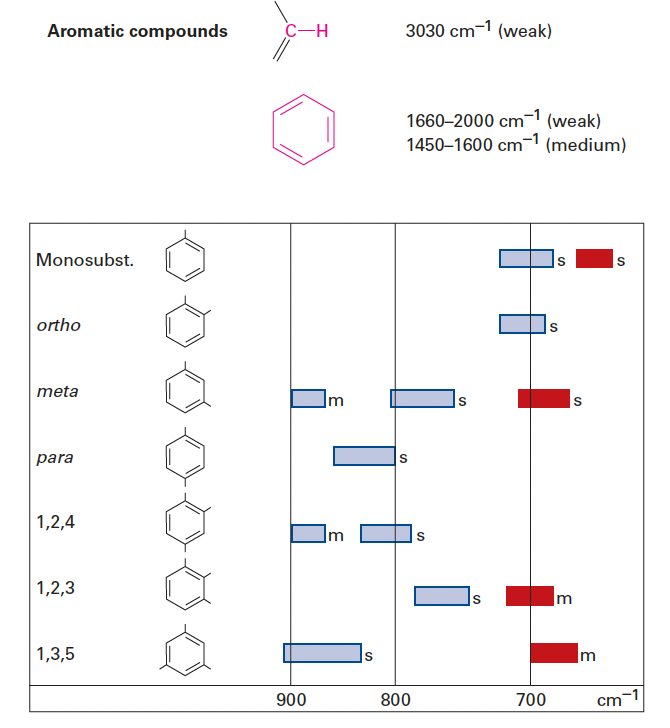
- 주요 흡수
- Ar–H stretch: 3030 cm⁻¹ (weak)
- 방향족 C=C: 1450–1600 cm⁻¹ (medium)
- 1660–2000 cm⁻¹: 약한 복합 밴드
- C–H out-of-plane bending (650–1000 cm⁻¹)을 통해 치환 패턴(ortho/meta/para) 판단 가능
4. 알코올 (Alcohols)
- 주요 흡수
- O–H stretch: 3400–3650 cm⁻¹ (broad, intense)
- 수소결합 때문에 매우 넓은 밴드 형성 → 가장 식별이 쉬운 작용기 중 하나
- 예시: cyclohexanol의 IR spectrum

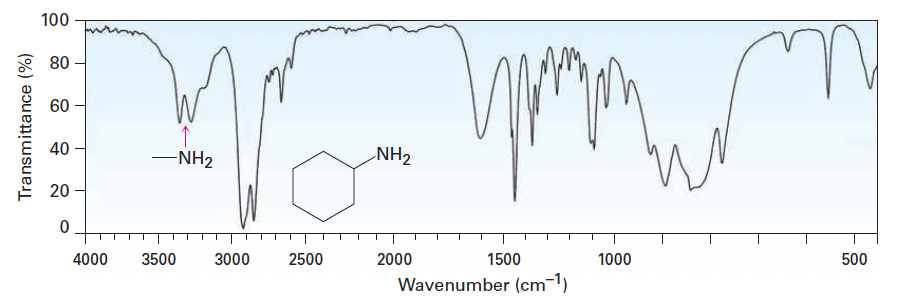
5. 아민 (Amines)
- 주요 흡수
- N–H stretch: 3300–3500 cm⁻¹ (sharp, medium)
- 1차 아민은 두 개의 N–H stretch, 2차 아민은 하나의 N–H stretch
- 알코올의 O–H보다 좁고 덜 강함
- 예시: cyclohexylamine의 IR spectrum
6. 카보닐 화합물 (Carbonyl compounds)의 개요
- 가장 특징적인 IR 흡수
- C=O stretch: 1670–1780 cm⁻¹ (sharp, strong)
- 정확한 파수는 작용기 종류, 공명, 유도효과, 고리 장력에 따라 달라짐
6-1. 알데하이드 (Aldehydes)

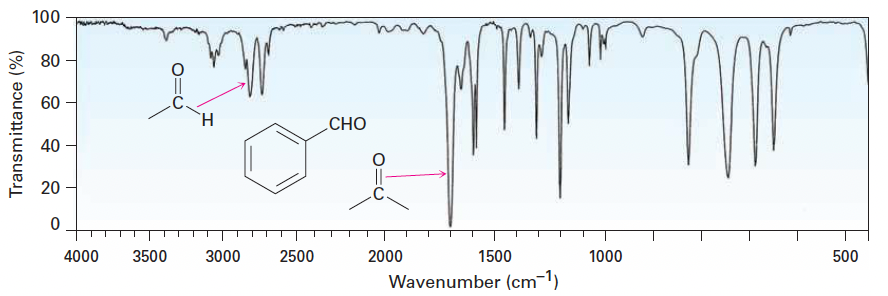
- C=O stretch
- 포화 알데하이드: 1730 cm⁻¹
- 공명(conjugation) 알데하이드: 1705 cm⁻¹
- 특징적 C–H stretch (–CHO): 2750, 2850 cm⁻¹
- 케톤과의 구분에 유용함
- 예시: benzaldehyde의 IR spectrum
6-2. 케톤 (Ketones)
- C=O stretch
- saturated ketone: 1715 cm⁻¹
- 5-membered cyclic ketone: 1750 cm⁻¹
- 4-membered cyclic ketone: 1780 cm⁻¹
- aromatic ketone: 1690 cm⁻¹
- 공명 카보닐은 일반적으로 20–30 cm⁻¹ 낮게 이동
6-3. 에스터 (Esters)
- C=O stretch
- 포화 에스터: 1735 cm⁻¹
- 공명 에스터: 1715 cm⁻¹
- C–O stretch: 1300–1000 cm⁻¹ (두 개의 강한 밴드)
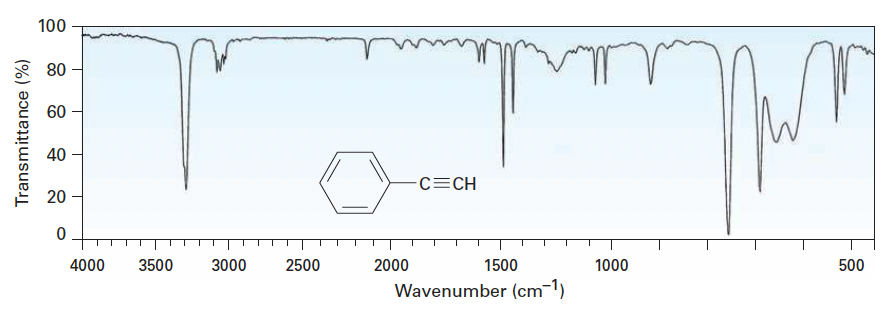
Problem 12-9. The IR spectrum of phenylacetylene is shown. What absorption bands can you identify?
Answer.
≡C–H stretch at ~3300 cm⁻¹, C≡C stretch at ~2100–2260 cm⁻¹, aromatic C–H stretch near 3030 cm⁻¹, aromatic C=C absorptions at 1450–1600 cm⁻¹, aromatic out-of-plane C–H bending near 750 cm⁻¹.
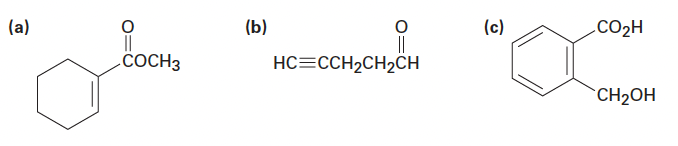
Problem 12-10. Where might the following compounds have IR absorptions?
Answer.
(a) C=O stretch ~1715 cm⁻¹, alkene C=C ~1640–1680 cm⁻¹, =C–H stretch ~3020–3100 cm⁻¹.
(b) ≡C–H stretch ~3300 cm⁻¹, C≡C stretch ~2100–2260 cm⁻¹, aldehyde C=O ~1730 cm⁻¹, aldehyde C–H ~2750 cm⁻¹.
(c) Carboxylic acid O–H (very broad) ~2500–3100 cm⁻¹, C=O ~1710 cm⁻¹, alcohol O–H ~3400–3650 cm⁻¹.
Problem 12-11. Where might the following compound have IR absorptions?

Answer.
C=O stretch ~1715–1735 cm⁻¹, C–H stretches (sp³) 2850–2960 cm⁻¹, C–C/C–O absorptions in the fingerprint region.
'전공필수 > 유기화학 (Organic chemistry)' 카테고리의 다른 글
| [유기화학] 13-2. NMR 흡수의 본질 (The Nature of NMR Absorptions) (0) | 2026.02.01 |
|---|---|
| [유기화학] 13-1. 핵자기공명 분광법 (Nuclear Magnetic Resonance Spectroscopy) (0) | 2026.01.31 |
| [유기화학] 12-7. 적외선 스펙트럼 해석 (Interpreting Infrared Spectra) (0) | 2026.01.24 |
| [유기화학] 12-6. 적외선 분광법 (Infrared Spectroscopy) (1) | 2026.01.23 |
| [유기화학] 12-5. 분광법과 전자기 스펙트럼 (Spectroscopy and the Electromagnetic Spectrum) (1) | 2026.01.22 |