1. 그리냐르 시약 (Grignard Reagents)

- 유기 할로겐 화합물(RX)과 마그네슘 금속(Mg)을 에테르 또는 THF 용매에서 반응시켜 제조함. (챕터 10-6 참조)
- 탄소-마그네슘 결합은 강한 극성을 띠며, 탄소 원자가 친핵성(nucleophilic)과 염기성(basic) 성질을 가짐.
- R-X + Mg -> R-Mg-X (Grignard reagent)
2. 그리냐르 반응을 이용한 알코올 합성

- 그리냐르 시약의 탄소 음이온이 카보닐기의 탄소를 공격하여 새로운 C-C 결합을 형성함.
- 포름알데하이드(Formaldehyde): 일차(1°) 알코올 생성.

- 알데하이드(Aldehyde): 이차(2°) 알코올 생성.
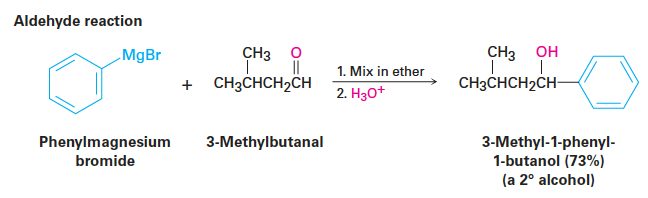
- 케톤(Ketone): 삼차(3°) 알코올 생성.

- 에스터(Ester): 삼차(3°) 알코올 생성 (그리냐르 시약 2당량 소모).

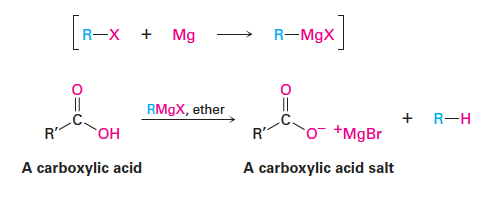
- 카복실산(Carboxylic acid): 그리냐르 반응하지 않고 마그네슘 염을 만듦.
3. 그리냐르 반응의 제한성

- 그리냐르 시약은 매우 강한 염기이므로, 분자 내에 산성 수소(-OH, -NH, -SH, -COOH)가 있는 화합물과는 친핵성 부가 반응 대신 산-염기 반응을 일으켜 파괴됨.
- 따라서 이러한 작용기가 포함된 화합물에는 그리냐르 반응을 직접 사용할 수 없음. (ex. 카복실산)
4. 그리냐르 반응 메커니즘
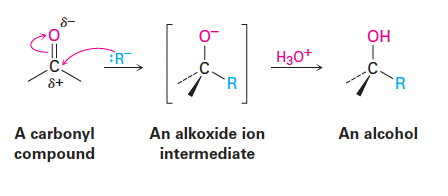
- 친핵체인 R:- 가 카보닐 탄소를 공격하여 사면체형 알콕사이드 중간체를 형성함.
- 이후 산성 수용액 처리를 통해 양성자화(protonation)되어 최종 알코올이 됨.
Problem 17-9. Show the products obtained from addition of methylmagnesium bromide to the following compounds:
(a) Cyclopentanone (b) Benzophenone (c) 3-Hexanone
Answer.
(a) 1-Methylcyclopentan-1-ol (b) 1,1-Diphenylethan-1-ol (c) 3-Methylhexan-3-ol
Problem 17-10. Use a Grignard reaction to prepare the following alcohols:
(a) 2-Methyl-2-propanol (b) 1-Methylcyclohexanol (c) 3-Methyl-3-pentanol
(d) 2-Phenyl-2-butanol (e) Benzyl alcohol (f) 4-Methyl-1-pentanol
Answer.
(a) Acetone + Methylmagnesium bromide (b) Cyclohexanone + Methylmagnesium bromide
(c) 3-Pentanone + Methylmagnesium bromide (d) Acetophenone + Ethylmagnesium bromide
(e) Formaldehyde + Phenylmagnesium bromide (f) 1-Bromo-3-methylbutane으로 만든 Grignard 시약 + Formaldehyde
Problem 17-11. Use the reaction of a Grignard reagent with a carbonyl compound to synthesize the following compound:

Answer.
2-Methylcyclohexanone + EtMgBr
'전공필수 > 유기화학 (Organic chemistry)' 카테고리의 다른 글
| [유기화학] 17-7. 알코올의 산화 (Oxidation of Alcohols) (0) | 2026.04.03 |
|---|---|
| [유기화학] 17-6. 알코올의 반응 (Reactions of Alcohols) (0) | 2026.04.02 |
| [유기화학] 17-4. 카보닐 화합물로부터 알코올의 제조: 환원 (Alcohols from Carbonyl Compounds: Reduction) (0) | 2026.03.31 |
| [유기화학] 17-3. 알코올의 제조: 복습 (Preparation of Alcohols: A Review) (0) | 2026.03.30 |
| [유기화학] 17-2. 알코올과 페놀의 성질 (Properties of Alcohols and Phenols) (0) | 2026.03.29 |