
1. 알코올의 산 촉매 탈수 반응 (Acid-Catalyzed Dehydration of Alcohols)
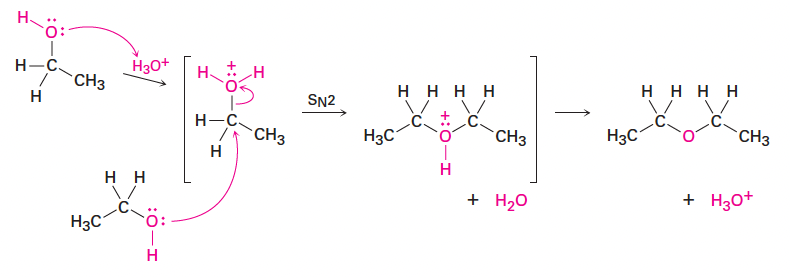
- 반응 개요
- 황산 촉매 하에 알코올 분자 2개가 반응하여 대칭형 에테르(Symmetrical ethers)를 형성함.
- 양성자화된 알코올 분자로부터 다른 알코올 분자의 산소 원자가 물을 밀어내는 SN2 치환 반응으로 진행됨.
- 제한 사항
- 일차(Primary) 알코올에만 유용함.
- 이차(Secondary) 및 삼차(Tertiary) 알코올은 E1 메커니즘에 의한 탈수 반응이 우선하여 알켄(Alkenes)을 형성하기 때문임.
2. Williamson 에테르 합성 (The Williamson Ether Synthesis)
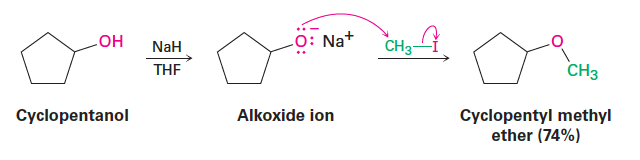
- 반응 메커니즘
- 알콕사이드 이온(Alkoxide ion)이 일차 할로젠화 알킬(Primary alkyl halide) 또는 토실레이트(Tosylate)와 반응하는 SN2 반응임.
- 알콕사이드 이온은 대개 알코올과 강염기(예: NaH)를 반응시켜 준비함.
- Ag2O를 이용한 변형
- 산화 은(Ag2O)을 약염기로 사용하면 알코올을 미리 알콕시드로 만들 필요 없이 할로젠화 알킬과 직접 반응시킬 수 있음.
- 당류(Sugars)의 하이드록시기를 에테르로 전환할 때 매우 유용함 (예: Glucose의 메틸화).

- 반응의 제한 및 설계
- SN2 반응이므로 입체 장애의 영향을 받음.
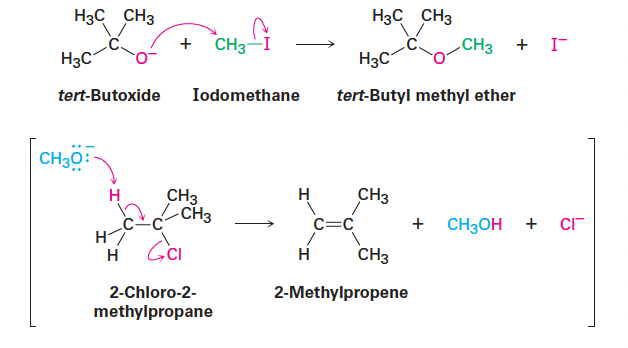
- 비대칭 에테르 합성 시, 더 입체 장애가 큰 쪽을 알콕시드로 사용하고 입체 장애가 적은 쪽(일차 할킬 할라이드 등)을 기질로 선택해야 함. (예: tert-butoxide + iodomethane은 가능하지만, 2-chloro2-methylpropane과 methoxide ion은 안 됨)
- 삼차 할로젠화 알킬을 기질로 사용하면 SN2 대신 E2 제거 반응이 일어나 알켄이 생성됨.
3. 알켄의 알콕시수은화-탈수은화 (Alkoxymercuration of Alkenes)
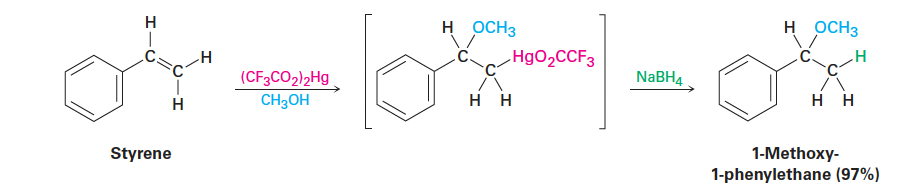
- 반응 메커니즘
- 1) 알켄 + 알코올 용매 + Trifluoroacetate 수은 [(CF3CO2)2Hg] 2) NaBH4로 환원
- 마르코브니코프(Markovnikov) 규칙에 따라 알코올이 더 많이 치환된 탄소에 결합함.
- 특징
- 일차, 이차, 삼차 알코올 모두 잘 반응함.
- 다만, 입체 장애로 인해 디삼차(Ditertiary) 에테르는 제조할 수 없음.
Problem 18-2. Why do you suppose only symmetrical ethers are prepared by the sulfuric-acid-catalyzed dehydration procedure? What product(s) would you expect if ethanol and 1-propanol were allowed to react together? In what ratio would the products be formed if the two alcohols were of equal reactivity?
Answer.
비대칭 에테르를 제조하려고 하면 세 종류의 에테르 혼합물(R-O-R, R'-O-R', R-O-R')이 생성되어 분리가 어렵기 때문임. Ethanol과 1-propanol을 반응시키면 Diethyl ether, Dipropyl ether, Ethyl propyl ether가 생성되며, 반응성이 같다면 1:1:2의 비율로 형성됨.
Problem 18-3. How would you prepare the following ethers using a Williamson synthesis?
(a) Methyl propyl ether (b) Anisole (methyl phenyl ether) (c) Benzyl isopropyl ether (d) Ethyl 2,2-dimethylpropyl ether
Answer.
(a) CH3CH2CH2O- + CH3I
(b) Phenoxide ion + CH3I
(c) (CH3)2CHO- + Benzyl bromide
(d) CH3CH2O- + 2,2-dimethylpropyl tosylate (또는 (CH3)3CCH2O- + CH3CH2I)
Problem 18-4. Review the mechanism of oxymercuration shown in Figure 8-3 on page 230, and then write the mechanism of the alkoxymercuration reaction of 1-methylcyclopentene with ethanol. Use curved arrows to show the electron flow in each step.
Answer.
1-Methylcyclopentene에 Hg(II)가 첨가되어 mercurinium ion 중간체를 형성하고, Ethanol이 더 많이 치환된 탄소(1번 위치)를 공격한 후 NaBH4에 의해 탈수은화되어 1-ethoxy-1-methylcyclopentane이 생성됨.
Problem 18-5. How would you prepare the following ethers? Use whichever method you think is more appropriate, Williamson synthesis or the alkoxymercuration reaction.
(a) Butyl cyclohexyl ether (b) Benzyl ethyl ether (c) sec-Butyl tert-butyl ether (d) Tetrahydrofuran
Answer.
(a) Alkoxymercuration (Cyclohexene + 1-Butanol)
(b) Williamson synthesis (Ethoxide + Benzyl bromide)
(c) Alkoxymercuration (2-Methylpropene + 2-Butanol)
(d) Williamson synthesis (4-Chlorobutan-1-ol + NaOH를 통한 분자 내 반응)
Problem 18-6. Rank the following halides in order of their reactivity in Williamson synthesis:
(a) Bromoethane, 2-bromopropane, bromobenzene (b) Chloroethane, bromoethane, 1-iodopropene
Answer.
(a) Bromoethane > 2-bromopropane > bromobenzene (반응 안 함)
(b) Bromoethane > Chloroethane > 1-iodopropene (반응 안 함)
'전공필수 > 유기화학 (Organic chemistry)' 카테고리의 다른 글
| [유기화학] 18-4. 에테르의 반응: 클라이젠 재배열 (Reactions of Ethers: Claisen Rearrangement) (0) | 2026.04.15 |
|---|---|
| [유기화학] 18-3. 에테르의 반응: 산 촉매 분해 (Reactions of Ethers: Acidic Cleavage) (0) | 2026.04.14 |
| [유기화학] 18-1. 에테르의 명명법과 성질 (Names and Properties of Ethers) (0) | 2026.04.12 |
| [유기화학] 17-11. 알코올과 페놀의 분광법 (Spectroscopy of Alcohols and Phenols) (0) | 2026.04.07 |
| [유기화학] 17-10. 페놀의 반응 (Reactions of Phenols) (0) | 2026.04.06 |