반응형

1. 수소 원자 수와 피크 면적의 관계
- NMR 스펙트럼에서 각 피크 아래의 면적은 그 흡수를 일으키는 수소 원자의 수에 비례함.
- 분자 내 서로 다른 종류의 수소 원자들의 상대적인 수를 측정하는 것이 가능함.
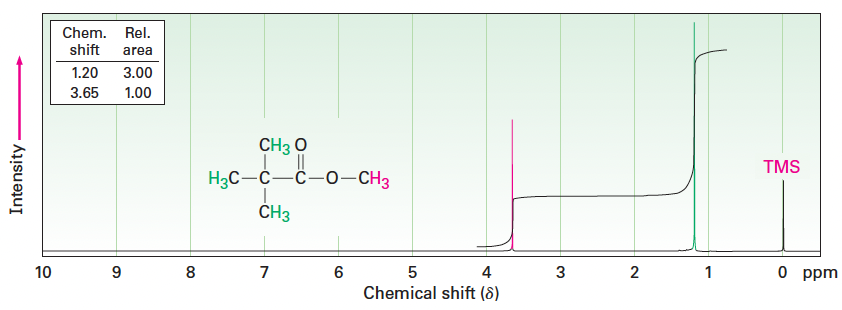
- 예시: Methyl 2,2-dimethylpropanoate
- 1.2 δ 피크((CH₃)₃C-)가 3.7 δ 피크(-OCH₃)보다 더 크게 나타나는데, 이는 각 피크를 만드는 수소의 개수가 다르기 때문임.
- 상대적 면적을 계산하면 1:3으로, 실제 수소 개수의 비율과 일치함(3:9).
2. 적분(Integration) 측정 방법
- 현대적인 NMR 기기: 상대적인 피크 면적을 디지털 수치(digital readout)로 직접 제공함.
- 과거 및 시각적 방법: 적분된 피크 면적을 계단 모양의 선(stair-step line)으로 표시함.
- 계단 높이의 의미: 각 계단의 높이는 피크 아래의 면적에 비례하며, 결과적으로 해당 피크를 만드는 수소의 상대적 원자 수에 비례함.
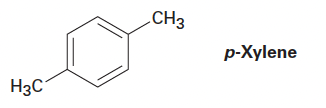
Problem 13-8. How many peaks would you expect in the 1H NMR spectrum of 1,4-dimethylbenzene (para-xylene, or p-xylene)? What ratio of peak areas would you expect on integration of the spectrum? Refer to Table 13-3 for approximate chemical shifts, and sketch what the spectrum would look like. (Remember from Section 2-4 that aromatic rings have two resonance forms.)
Answer.
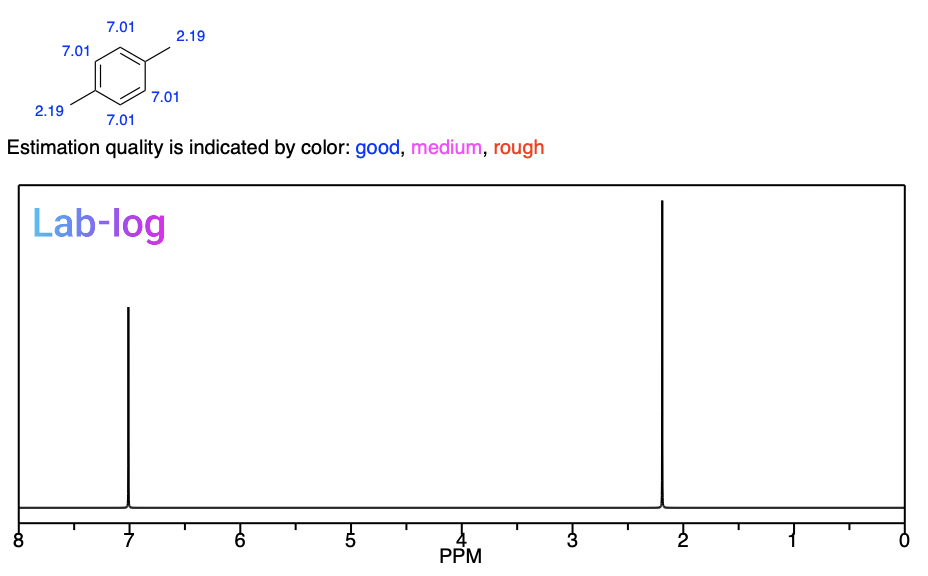
Number of peaks: 2 peaks
Ratio of peak areas (Aromatic : Methyl): 4 : 6 (또는 2 : 3)
Chemical shifts: Aromatic protons (약 7.0 δ), Methyl protons (약 2.3 δ)
반응형