반응형

- 알켄의 생성은 보통 제거반응(elimination reaction)을 통해 이루어진다.
- 첨가(addition) 반응: 알켄 → 알킬 할라이드 / 알코올
- 제거(elimination) 반응: 알킬 할라이드 / 알코올 → 알켄
- 두 가지 주요 제거반응
(1) 탈할로젠산 반응 (Dehydrohalogenation)
- 알킬 할라이드로부터 HX 제거: 강염기(KOH, NaOEt 등)가 필요
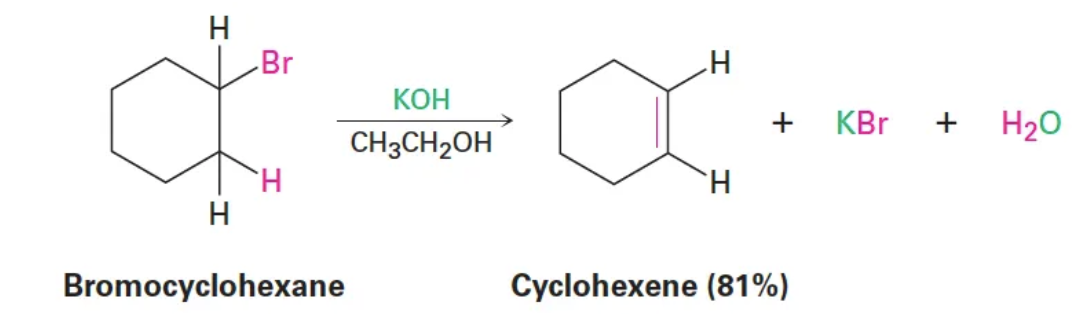
- 예: Bromocyclohexane + KOH → Cyclohexene (81%) + KBr + H2O
(2) 탈수 반응 (Dehydration)
- 알코올 → 알켄 + 물: 강산(H₂SO₄), 가열 필요
- 카보양이온을 거치는 E1 반응이 흔함
- 예: 1-methylcyclohexanol → 1-methylcyclohexene + H₂O (91%)

- 생체 내 탈수반응: 생물학적 경로에서 알코올 단독으로 탈수되는 경우는 거의 없으며, 보통 β-위치에 카보닐기가 있는 구조, 즉 β-hydroxy carbonyl 형태가 탈수된다.
- 예: β-hydroxybutyryl-ACP → trans-crotonyl-ACP + H₂O → 지방산 β-산화 경로와 관련
- 제거반응의 특징: 제거반응은 종종 여러 알켄을 혼합물로 생성한다.
- 이유: 어떤 β-수소가 제거되느냐에 따라 서로 다른 위치에 이중결합이 생김. 또한 E/Z 이성질체도 발생 가능.
Problem 8-1. One problem with elimination reactions is that mixtures of products are often formed. For example, treatment of 2-bromo-2-methylbutane with KOH in ethanol yields a mixture of two alkene products. What are their likely structures?
Answer. 2-methyl-1-butene, 2-methyl-2-butene
Problem 8-2. How many alkene products, including E,Z isomers, might be obtained by dehydration of 3-methyl-3-hexanol with aqueous sulfuric acid?

Answer.
총 4가지 가능
3-methyl-3-hexene (E, Z), 3-methyl-2-hexene (E, Z)
반응형