1) 유기합성의 목적과 사고방식
- 유기합성은 약물 개발, 화학 산업의 효율적 공정 설계, 학술적 탐구 등 다양한 목적을 위해 수행된다.
- 핵심은 어떤 목표 분자를 더 단순한 전구체로부터 합성할 수 있는 경로를 계획하는 능력이다.
- 합성 계획의 본질은 다음 두 가지에 있다.
- 기능기(Functional group) 인식: 목표 분자가 어떤 기능기를 갖고 있는지 파악한다.
- 역합성적 사고(retrosynthesis): 목표 분자를 한 단계 전(precursor) 물질로 거꾸로 되돌려 올라가며 “이 기능기를 만들기 직전 형태는 무엇인가?”를 반복적으로 생각한다.
- 예를 들어 최종 생성물이 알킬 할라이드라면, 바로 직전 전구체는 알켄일 가능성이 있으며 HX를 첨가하면 알킬 할라이드를 만들 수 있다.
- 만약 최종 생성물이 cis-알켄이라면, 바로 직전 전구체는 알카인이며 Lindlar 촉매로 부분 환원하면 cis-알켄을 얻을 수 있다.
2) 합성 경로 설계 예시
예시 1: cis-2-Hexene을 1-Pentyne과 알킬 할라이드로부터 합성
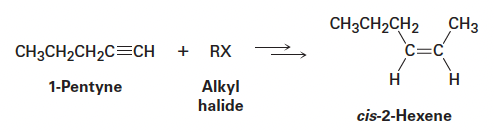
핵심 기능기: cis-이중결합 → 직전 전구체: 알카인 (2-Hexyne) → 2-Hexyne을 Lindlar 촉매로 환원하면 cis-2-Hexene 생성
다음 질문: 2-Hexyne의 전구체는? → 1-Pentyne의 아세틸라이드 음이온 + CH₃I → 2-Hexyne
따라서 합성 경로는:

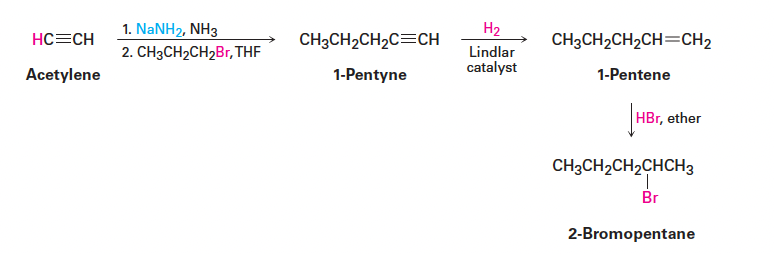
예시 2: Acetylene으로부터 2-Bromopentane 합성

기능기: 알킬 브로마이드 → 전구체: 알켄 + HBr (Markovnikov) → 알켄 전구체: 알카인 + Lindlar 촉매 → 알켄
전체 순서:
예시 3: 5-Methyl-1-hexanol의 합성 (acetylene + alkyl halide)

기능기: 1° 알코올
→ 전구체: terminal alkene → (hydroboration–oxidation) → alcohol
→ 전구체 알켄: Lindlar 촉매로 알카인을 부분 환원
→ 전구체 알카인: acetylene + alkyl halide 2단계 알킬화
전체 경로:

*hydroboration–oxidation 단계는 non-Markovnikov regioselectivity로 1° 알코올을 형성하는 중요한 기능기 변환임을 강조하며, 전체 합성 흐름에서 마지막 단계의 역할을 보여준다.
Problem 9-12. Beginning with 4-octyne as your only source of carbon, and using any inorganic reagents necessary, how would you synthesize the following compounds?
(a) cis-4-Octene (b) Butanal (c) 4-Bromooctane
(d) 4-Octanol (e) 4,5-Dichlorooctane (f) Butanoic acid
Answer.
(a) H₂, Lindlar catalyst
(b) Hydroboration–oxidation, then cleavage
(c) HBr (Markovnikov)
(d) BH₃, then H₂O₂/NaOH
(e) Cl₂
(f) KMnO₄ or O₃ oxidative cleavage
Problem 9-13. Beginning with acetylene and any alkyl halide needed, how would you synthesize the following compounds?
(a) Decane (b) 2,2-Dimethylhexane (c) Hexanal (d) 2-Heptanone
Answer.
(a) Sequential dialkylation with two C₅ alkyl halides
(b) Alkylate with neopentyl halide equivalents twice
(c) Partial reduction to alkene → hydroboration–oxidation → aldehyde formation
(d) Alkylation → hydration under Hg²⁺ catalysis → ketone formation