1. 콘쥬게이션 다이엔의 친전자성 첨가 반응 특징
- 콘쥬게이션 다이엔은 전형적인 알켄과 마찬가지로 친전자성 첨가 반응을 잘 일으키나, 생성물이 혼합물로 얻어진다는 점이 다름.
- 1,3-Butadiene에 HBr을 첨가하면 두 가지 생성물이 생성됨.
- 1,2-첨가 생성물 (1,2-addition product): 이중 결합 하나에 마르코브니코프(Markovnikov) 규칙에 따라 첨가된 형태임 (예: 3-Bromo-1-butene, 71%).
- 1,4-첨가 생성물 (1,4-addition product): 이중 결합이 2번과 3번 탄소 사이로 이동하고 1번과 4번 탄소에 H와 Br이 첨가된 형태임 (예: 1-Bromo-2-butene, 29%).

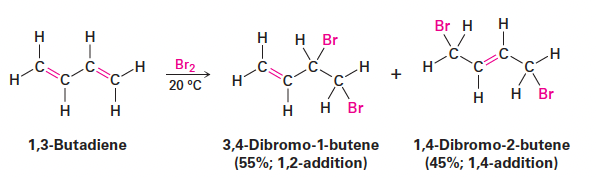
- Br2와 같은 다른 친전자체도 1,3-Butadiene과 반응하여 3,4-dibromo-1-butene(1,2-첨가)과 1,4-dibromo-2-butene(1,4-첨가)의 혼합물을 형성함.
2. 알릴 탄소 양이온 중간체 (Allylic Carbocations)
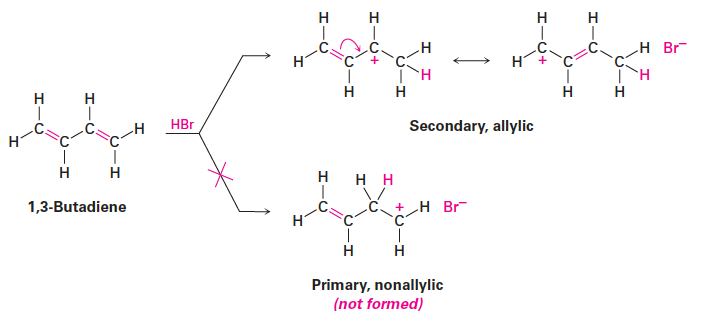
- 1,4-첨가 생성물이 형성되는 이유는 반응 중간체로 알릴 탄소 양이온(allylic carbocation)이 형성되기 때문임.
- 1,3-Butadiene이 양성자(H+)와 반응할 때, 1차 탄소 양이온(Primary nonallylic)보다 공명에 의해 안정화되는 2차 알릴 탄소 양이온(Secondary allylic)이 우선적으로 형성됨.
- 알릴 탄소 양이온은 두 공명 구조 사이의 공명 혼성체로 존재하며, 양전하가 C1과 C3 탄소에 분산됨.
- 따라서 음이온(Br-)이 C1에 결합하면 1,4-첨가 생성물이, C3에 결합하면 1,2-첨가 생성물이 생성됨.
3. 정전기 전위 지도 분석
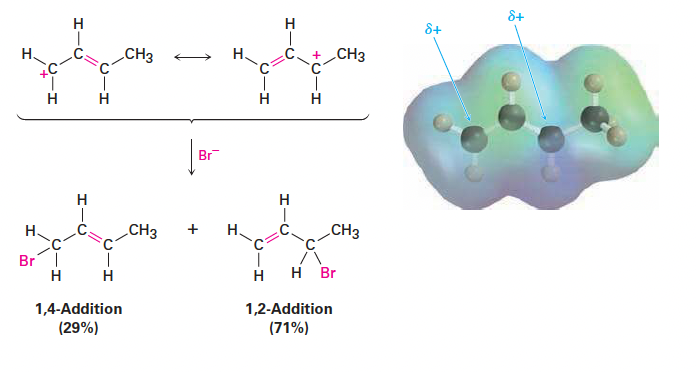
- 1,3-Butadiene의 정전기 전위 지도는 알릴 탄소 양이온에서 양전하(파란색 부분)가 C1과 C3 탄소에 공유되어 있음을 보여줌.
- 더 많은 양전하를 띠는 탄소(C3)와 Br-이 반응하면 1,2-첨가 생성물이 주로 얻어짐.
Worked Example 14-1. Predicting the Product of an Electrophilic Addition Reaction of a Conjugated Diene
Give the structures of the likely products from reaction of 1 equivalent of HCl with 2-methyl-1,3-cyclohexadiene. Show both 1,2 and 1,4 adducts.
Solution.
- C1-C2 이중 결합의 양성자 첨가는 3-chloro-3-methylcyclohexene (1,2-adduct)과 3-chloro-1-methylcyclohexene (1,4-adduct)을 생성함.
- C3-C4 이중 결합의 양성자 첨가는 대칭적인 탄소 양이온을 거쳐 동일한 구조인 6-chloro-1-methylcyclohexene (1,2 및 1,4-adduct 공통)을 생성함.
- C1-C2 위치의 양성자 첨가가 더 안정적인 3차 알릴 탄소 양이온을 형성하므로 더 유리함.
Problem 14-2. Give the structures of both 1,2 and 1,4 adducts resulting from reaction of 1 equivalent of HCl with 1,3-pentadiene.
Answer.
4-chloro-2-pentene (1,2-adduct), 1-chloro-2-pentene (1,4-adduct) [from C1 protonation]
2-chloro-3-pentene (1,2-adduct), 5-chloro-3-pentene (1,4-adduct) [from C4 protonation]
Problem 14-3. Look at the possible carbocation intermediates produced during addition of HCl to 1,3-pentadiene (Problem 14-2), and predict which 1,2 adduct predominates. Which 1,4 adduct predominates?
Answer.
1,2-adduct: 4-chloro-2-pentene
1,4-adduct: 1-chloro-2-pentene
(C1 양성자 첨가로 생성된 2차 알릴 탄소 양이온이 C4 양성자 첨가로 생성된 2차 알릴 탄소 양이온보다 더 안정함)
Problem 14-4. Give the structures of both 1,2 and 1,4 adducts resulting from reaction of 1 equivalent of HBr with the following compound: (1,2-dimethylcyclohexene structure)
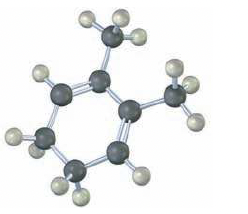
Answer.
3-bromo-2,3-dimethylcyclohexene (1,2-adduct), 3-bromo-1,2-dimethylcyclohexene (1,4-adduct)